
Here is something most dog owners discover the hard way: a long walk is not enough. You can march your dog for an hour, come home exhausted, and watch them tear around the living room twenty minutes later like they have done nothing all day. The missing piece is not more physical exercise. It is mental exercise. A dog’s brain needs a workout just as much as its body, and when it does not get one, that unspent mental energy comes out as barking, chewing, digging, and general chaos.
The good news is that mental stimulation is quick, cheap, and genuinely fun for both of you. Ten to fifteen minutes of brain work can leave a dog more satisfied than an hour of walking, because problem-solving and sniffing are naturally tiring in a way that trotting along a pavement simply is not. This guide gives you fifteen games, from thirty-second warm-ups to proper brain-teasers, most using things already in your kitchen.
Why mental stimulation matters more than you think
Dogs were bred to work. Retrievers retrieved, collies herded, terriers hunted vermin, scent hounds tracked. We took the jobs away but left the brains that need them. A modern pet dog often spends 22 hours a day doing very little, and an under-stimulated brain does not just sit there quietly. It looks for something to do, and the something is usually a behaviour you do not want.
This is the root of an enormous number of “problem” behaviours. The barking, the shredded cushions, the counter-surfing, the digging, so much of it traces back to a bored dog inventing its own entertainment. Fix the boredom and a remarkable amount of the bad behaviour simply melts away. That is exactly why we point owners struggling with barking or destructive habits here first.
How much mental stimulation does a dog need?
Less than you would expect, which is the encouraging part. Two or three short sessions a day, ten to fifteen minutes each, makes a real difference for most dogs. High-drive breeds like collies, shepherds, poodles, and spaniels need more, and you will know because they get “creative” when they do not get it. Older dogs benefit too, because mental work helps keep an ageing brain sharp. The trick is little and often, woven into the day, rather than one big session.
A brilliant shortcut is to feed your dog through these games instead of from a bowl. Every meal becomes a job. This alone transforms restless dogs, and it costs you nothing extra.
Quick wins: games you can start in 30 seconds
1. The scatter feed
The simplest brain game there is. Instead of putting your dog’s kibble in a bowl, scatter it across the lawn or a snuffle-friendly rug and let them sniff it out. Sniffing is deeply satisfying and calming for dogs, and this turns a ten-second meal into a ten-minute foraging session.
2. The muffin tin puzzle
Drop treats into the cups of a muffin tin, then cover each cup with a tennis ball. Your dog has to nudge and lift the balls to get the reward. Cheap, effective, and endlessly reusable.
3. The towel roll
Lay a treat along a hand towel, roll it up, and let your dog unravel it to find the prize. Increase the difficulty by folding treats into a scrunched-up towel instead.
4. Hide and seek (treats)
Pop your dog in another room, hide a few treats around the living room, then release them with a cue like “find it.” Start easy and obvious, then make the hiding spots trickier as they get the idea. This taps straight into their natural scenting drive.
5. Hide and seek (you)
The same game, but you are the prize. Hide behind a door or the sofa and call your dog once. When they find you, throw a little party. This builds mental engagement and quietly strengthens your recall at the same time.
Building brains: proper puzzle games
6. The snuffle mat
A snuffle mat is a fabric mat with dozens of folds and pockets that you hide food in. Your dog roots through it with their nose, and it is one of the most reliably calming activities you can offer an anxious or over-aroused dog. You can buy one cheaply or make one by knotting strips of fleece through a rubber sink mat.
7. Treat-dispensing toys
Toys like a stuffed rubber Kong or a wobble feeder make your dog work for food by licking, rolling, and nudging. Stuff a Kong with wet food and freeze it for a longer-lasting challenge that is perfect for settling a dog when you leave the house. We round up the best options in our guide to the best puzzle feeders for dogs.
8. Interactive puzzle boards
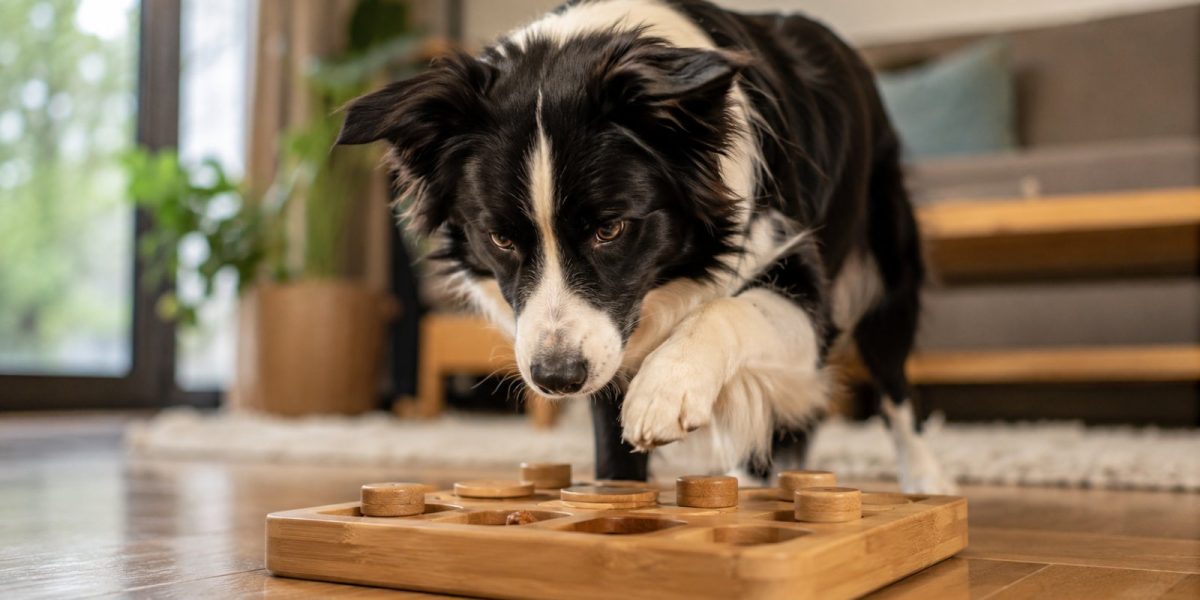
These are the shop-bought puzzles with sliding tiles, flip lids, and hidden compartments. They come in difficulty levels, so you can start easy and work up. Watching a dog figure one out for the first time is genuinely delightful, and you can see the concentration on their face.
9. The three-cup game
Take three cups, let your dog watch you hide a treat under one, shuffle them, and let them pick. This is real problem-solving and object permanence, and clever dogs get eerily good at it.
10. The “which hand” game
Hide a treat in one closed fist, present both hands, and let your dog nose or paw the right one. Thirty seconds, no setup, brilliant for a rainy day.
Games that double as training
The best mental stimulation is often teaching your dog new things, because learning is hard mental work. These games build a smarter, more responsive dog and tire the brain beautifully.
11. Learn a new trick
Spin, bow, roll over, wave, “go to bed,” play dead. Every new trick is a mental workout. Break it into tiny steps, reward generously, and keep sessions to five minutes. Our trick training guide gives you a starter list.
12. Name their toys
Teach your dog the names of individual toys, then ask them to fetch “the ball” or “the rope.” Some dogs learn dozens of names. It is a proper cognitive challenge and a fantastic party trick.
13. Nose work / scent games
Introduce a “search” cue and hide a specific scented item or a favourite toy for your dog to track down. Formal scent work is a whole hobby you can do at home, and it is one of the most tiring activities for a dog because sniffing takes real mental effort. More in our guide to nose work games at home.
14. The obstacle course
Build a mini agility course from household objects: a broom across two chairs to step over, a box to weave around, a blanket tunnel. Guiding your dog through it combines body awareness with focus and following cues.
15. Tidy-up game
Teach your dog to put their toys back in a basket. It sounds advanced, but it is just “fetch” plus “drop it” in a specific spot, built up piece by piece. Owners love this one because it is useful and it seriously impresses visitors.
How to keep games challenging (so they don’t get bored)
Dogs get better at these games fast, and a game that is too easy stops being stimulating. Keep it fresh by raising the difficulty (harder hiding spots, tougher puzzles), rotating games so they do not become predictable, and adding a time or distance element. A game your dog solves instantly is a toy. A game that makes them pause and think is exercise.
This is exactly where a lot of well-meaning owners stall. They buy a puzzle, the dog cracks it, and they run out of ideas. The value of a structured program is that it gives you a proper progression, each game building on the last, so you are never guessing what to do next.
Want a done-for-you plan?
If you would rather follow a step-by-step system than piece games together yourself, this is precisely what Brain Training for Dogs is built for. It is an online course by a certified trainer that lays out brain games in order of difficulty, from beginner puzzles right up to advanced problem-solving, along with a troubleshooting section for specific issues like barking, chewing, and separation anxiety. The whole premise matches everything on this page: a mentally satisfied dog is a calm, well-behaved dog. We give it a full, honest going-over, the good and the not-so-good, in our Brain Training for Dogs review.
Frequently asked questions
How much mental stimulation does a dog need per day?
Most dogs do well with two or three short sessions of ten to fifteen minutes. High-energy and working breeds need more, and older dogs benefit from regular gentle brain work to stay sharp.
Is mental stimulation as good as a walk?
It is not a full replacement for physical exercise, but it is a powerful addition, and for tiring a dog out it is often more effective minute for minute. The ideal is to combine both.
Can mental stimulation stop bad behaviour?
Very often, yes. A huge amount of barking, chewing, and destructiveness comes from boredom. Meeting your dog’s mental needs removes the reason for many of these behaviours.
What are the best mental stimulation games for a puppy?
Keep it simple and short: scatter feeding, the towel roll, easy hide and seek, and gentle trick training like sit and touch. Puppies tire quickly, so a few minutes at a time is plenty.
Do I need to buy expensive toys?
No. Most games on this page use a muffin tin, towels, cups, or your own hands. Shop-bought puzzles and treat toys are a nice addition but completely optional.
My dog solves every puzzle instantly. What now?
Raise the difficulty and add new challenges, especially trick training and nose work, which scale endlessly. A structured program keeps the progression going so games stay genuinely challenging.
The bottom line
Mental stimulation is the most underrated tool in dog ownership. It is quick, it is cheap, and it solves problems that hours of walking never will. Start with a scatter feed tonight, add a puzzle or a hide-and-seek game this week, and mix in a new trick or two. Within days you will likely notice a calmer, more content dog, and a lot less of the behaviour that was driving you up the wall.
If you want the games laid out for you in a proper, build-as-you-go plan, read our Brain Training for Dogs review next, and if barking is your main battle, head to our full guide on how to stop a dog from barking.
Sources and further reading: American Kennel Club on cognitive games, ASPCA canine enrichment, and Purina brain games.