
There are few things more stressful than the suspicion, or the note through the door, that your dog barks the whole time you are out. You feel guilty, the neighbours are unhappy, and you cannot even see what is going on. Here is the reassuring part: barking when left alone is common and very fixable, once you work out why it is happening. Because the fix for a bored dog is completely different from the fix for an anxious one, and getting that right is the whole game. This guide shows you how to tell them apart and exactly what to do for each.
First, find out why: boredom or anxiety?
This is the single most important step, and most people skip it. Barking when alone usually comes from one of two very different places. Boredom and under-stimulation barking is a dog with energy and nothing to do, filling the silence. Separation anxiety barking is genuine panic at being left, and it needs a gentler, slower approach entirely. Treat anxiety like boredom and you will get nowhere; treat boredom like anxiety and you will over-complicate a simple fix.
The easiest way to tell the difference is to film your dog. Set up your phone or a pet camera, leave as normal, and watch the first fifteen minutes back. A bored dog barks on and off, wanders, naps, chews, and generally copes. An anxious dog shows distress fast: frantic pacing, drooling, scratching at doors, panting, and barking that sounds desperate rather than grumbly. If you see real panic, work through our guide to separation anxiety instead, because the rest of this article is aimed mainly at boredom barking and mild cases.
Tire the body and the brain before you leave
A tired dog is a quiet dog. The most effective single change most owners can make is a proper walk or play session before they head out, so your dog is ready to rest rather than roam and bark. But physical exercise is only half of it. Mental tiredness matters just as much, and a fifteen-minute brain workout can settle a dog more than a long walk. Our guide to mental stimulation games is full of quick options. Aim to leave your dog pleasantly worn out, not wired.
Give them a job for while you are gone
Leaving your dog with something absorbing to do turns your departure from a trigger into a treat. A stuffed, frozen food toy such as a Kong packed with wet food or peanut butter, a long-lasting chew, or a puzzle feeder scattered with part of their meal all give your dog a satisfying task right at the moment you leave. The licking and chewing are naturally calming, and a busy dog is not a barking dog. Save these special items for departures only, so they become something your dog actually looks forward to your leaving for.
Manage the environment
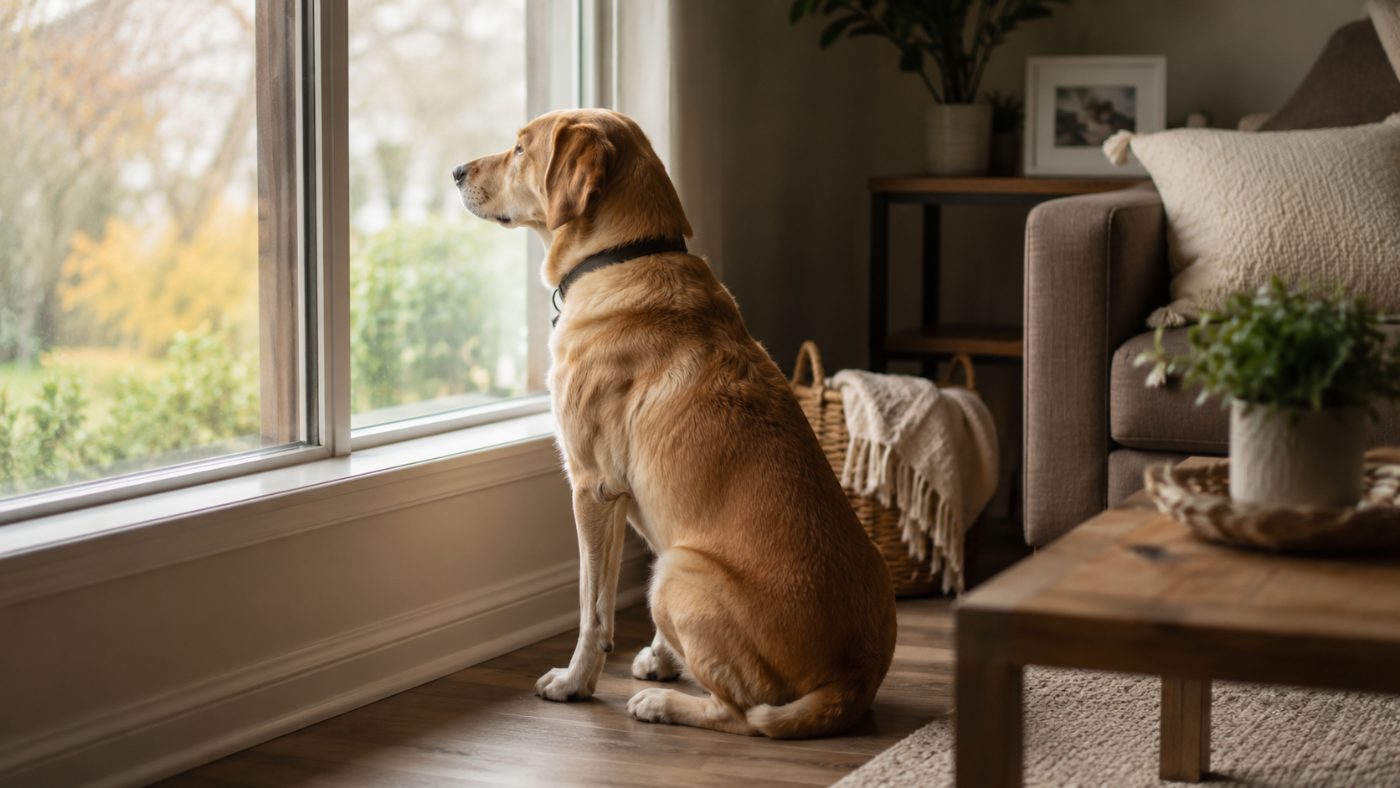
You can remove a lot of the triggers before you even start training. Leave a radio or television on at low volume to mask the street sounds, footsteps, and other dogs that set your dog off, and to make the house feel less empty. Choose a calm, quiet room as their home base, away from the front window and the front door, so there is less to react to. Block the view of the street with a stick-on frosted film or a closed curtain if your dog is a window-barker. None of this is cheating, it is simply making it easier for your dog to settle.

Train calm departures, step by step
Alongside the management, teach your dog that being alone is no big deal, and that quiet is what brings you back.
- Fade your leaving cues. Your dog starts worrying the moment you pick up keys or put on shoes. Do these things randomly through the day without leaving, so they stop predicting your departure.
- Keep goodbyes boring. No emotional farewells. Leave calmly and quietly, which teaches your dog that your going is nothing to get worked up about.
- Practise very short absences. Step out for a few seconds and come back, building up gradually. Only extend the time when your dog stays quiet and relaxed.
- Reward the quiet, not the bark. Time your return for a gap between barks, never mid-bark. If you come back while they are barking, you have just taught them that barking brings you home. Wait for a pause, then return and reward the calm.
Go at your dog’s pace. Short, successful reps beat one long session that ends in barking.
What not to do
- Do not use anti-bark collars. Shock and citronella collars punish the noise without fixing the cause, and for an anxious dog they make the underlying fear worse. We explain why in our piece on whether anti-bark collars work.
- Do not punish the barking after the fact. Coming home cross teaches your dog that your return is bad news, which increases anxiety and barking.
- Do not simply leave them longer to “get used to it.” For an anxious dog this backfires badly. Build up gradually instead.
- Do not reward the wrong moment. Letting your dog out, feeding, or returning while they bark all reinforce the barking. Wait for quiet.
When it is separation anxiety
If your camera footage showed genuine panic rather than boredom, the enrichment and management above will help a little, but they will not solve it on their own. True separation anxiety needs a dedicated desensitisation programme, keeping your dog under their panic threshold while you very gradually build up alone time, and sometimes veterinary support. Our full guide to helping a dog with separation anxiety walks through it, and a crate can help or hurt depending on the dog, which our crate training guide covers. For severe cases, please loop in your vet and a qualified behaviourist.
How long does it take?
For straightforward boredom barking, better exercise, a good food toy, and some environmental tweaks often bring a noticeable improvement within days. The departure training takes a little longer, typically one to three weeks of short, consistent practice, to really stick. Anxiety-driven barking takes longer, often several weeks to months, because you are changing an emotional response rather than just a habit. Whichever you are dealing with, consistency from everyone in the household is what gets you there.
Frequently asked questions
Why does my dog bark as soon as I leave?
Usually either boredom, an under-stimulated dog filling the silence, or separation anxiety, genuine panic at being left. Filming the first fifteen minutes tells you which. Boredom looks like grumbly, on-off barking with napping and chewing; anxiety looks like frantic distress.
Does leaving the TV or radio on help a dog stop barking?
Yes, for many dogs. Background noise masks the street sounds and passing dogs that trigger barking and makes an empty house feel less stark. It works best combined with exercise, enrichment, and departure training.
Should I get an anti-bark collar for barking when alone?
No. Anti-bark collars punish the symptom without addressing the cause and can worsen anxiety-based barking. Focus on exercise, enrichment, environmental management, and gradual departure training instead.
How do I stop my dog barking when left alone without hiring a trainer?
For boredom barking, tire your dog out first, leave a stuffed food toy, mask outside noise, keep goodbyes calm, and reward quiet on your return. If it is anxiety, follow a proper desensitisation plan and consider professional help.
Will getting a second dog stop the barking?
Not reliably. If the problem is boredom it might help a little, but if it is separation anxiety about you specifically, a second dog usually does not fix it and can even pick up the habit.
The bottom line
Barking when left alone almost always has a clear cause, and the fix follows the cause. Film your dog to tell boredom from anxiety. For boredom, tire them out, give them an absorbing food toy, mask the outside world, and train calm, gradual departures while rewarding quiet. For anxiety, slow right down and follow a proper desensitisation plan. Whatever you do, skip the anti-bark collars and the telling off. Next, dig into the root causes with our full guide on how to stop a dog from barking, and if it is anxiety, our separation anxiety guide.
Sources and further reading: American Kennel Club, ASPCA, and RSPCA.