

The first few months of a puppy’s life shape the dog they become for the rest of it, and socialization is the single most important thing you will do in that time. Get it right and you build a confident, friendly, unflappable adult dog. Miss the window and you risk fear, reactivity, and anxiety that are far harder to fix later. The good news is that socialization is not complicated, it is just a matter of positive, gradual exposure to the world during a specific window. This checklist walks you through exactly what to do, when to do it, and how to keep your puppy safe while you do.
What socialization really means (and what it does not)
Socialization is not just about meeting other dogs. It means gently and positively introducing your puppy to the full range of sights, sounds, surfaces, people, animals, and experiences they will meet in life, so that none of it feels frightening as an adult. The goal is not to overwhelm your puppy with everything at once. It is to create lots of small, calm, happy experiences where new things predict good stuff, usually a treat and your relaxed praise. Done well, socialization teaches your puppy one priceless lesson: the world is safe and interesting, not scary.
The critical window: why timing matters so much
Puppies have a critical socialization period that runs from roughly 3 to 14 weeks of age, and it starts closing fast after about 12 weeks. During this window their brains are wired to accept new things readily, so experiences they have now shape how they feel about the world for life. After around 16 weeks, that openness fades and a puppy becomes naturally more cautious of anything unfamiliar. This is why you cannot simply wait until your puppy is fully vaccinated to begin. The most valuable weeks would be gone. Instead, you socialize safely and early, which we will cover below.
Socializing safely before full vaccination
Here is the dilemma every new owner faces: the critical window opens before your puppy has finished their vaccinations, yet you need to protect them from disease. The answer, supported by veterinary behaviour experts, is not to keep your puppy locked away, but to socialize cleverly. Carry your puppy in your arms or a sling out in the world so they see and hear everything from safety. Use a pet stroller for busy places. Invite calm, vaccinated, friendly adult dogs to your home to meet your puppy. Have visitors of all kinds come to you. Take your puppy on car trips and let them watch the world from your lap in a parked spot. Avoid places where unknown dogs toilet, like public parks and pavements in high-traffic areas, until your vet gives the all-clear. You get all the exposure with almost none of the risk.
Watch out for the fear period
Somewhere around 8 to 11 weeks, right when most puppies move to their new homes, they go through a first fear period. During this phase a single scary experience can leave a lasting phobia, so this is the time for extra gentleness. Keep experiences positive and low-key, never force your puppy toward something they are worried about, and if they seem frightened, calmly increase the distance and let them approach in their own time. A frightening vet visit, a traumatic car ride, or being swamped by a boisterous crowd at this age can echo for years, so stack the deck with good experiences and let your puppy set the pace.
The core socialization checklist
Aim to introduce your puppy to as many items on this list as you can, always positively and always at your puppy’s pace. Keep treats handy and pair them with each new experience. You do not need to tick every box, but the more calm, positive exposures you bank, the more confident your adult dog will be.
People of all kinds
- Men, women, and children of different ages
- People wearing hats, hoods, sunglasses, and high-visibility jackets
- People with beards, umbrellas, walking sticks, and wheelchairs
- People of different ethnicities and appearances
- Delivery workers, cyclists, and joggers passing by
Sounds
- The vacuum cleaner, washing machine, and hairdryer
- Doorbells, knocking, and the phone ringing
- Traffic, sirens, and lorries
- Thunderstorms and fireworks (start quietly, using recordings if needed)
- Children playing, babies crying, and general household noise
Surfaces and environments
- Grass, gravel, sand, tiles, wooden floors, and metal grates
- Stairs, ramps, and wobbly or slippery surfaces
- Car rides, the vet’s waiting room, and pet-friendly shops
- Town centres, quiet woods, and busy streets (carried if not yet vaccinated)
Animals and handling
- Calm, friendly, fully vaccinated adult dogs
- Cats and other household pets, introduced slowly
- Livestock and wildlife seen calmly from a distance
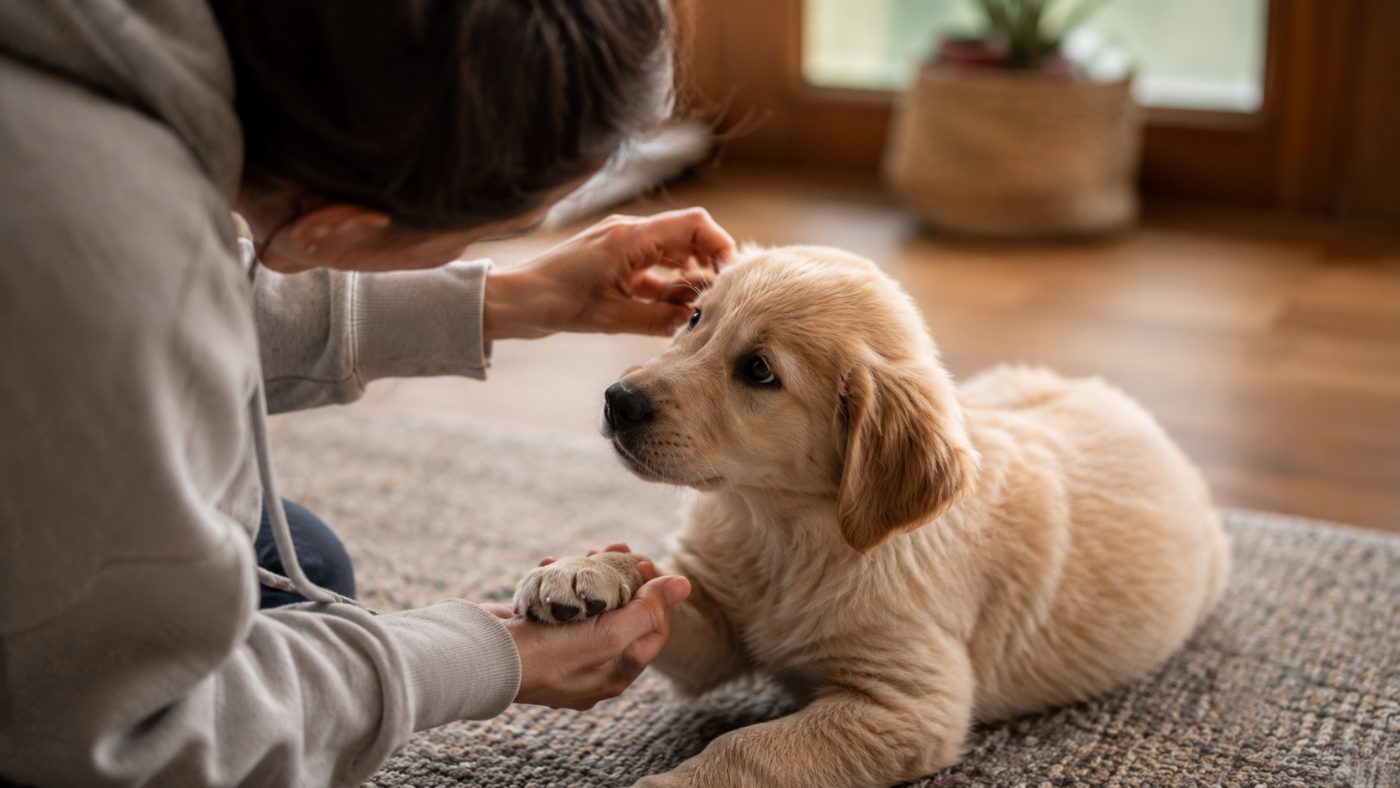
- Being gently handled all over: paws, ears, mouth, and tail, which makes vet visits and grooming far easier later
Week-by-week milestones
Every puppy is different, but here is a rough map of the socialization journey so you know what to focus on and when.
Weeks 3 to 5 (usually with the breeder)
Puppies start becoming aware of their littermates and surroundings, learning vital early social skills like bite inhibition and dog body language through play with their siblings. This is one reason a good, ethical breeder who handles the pups gently and exposes them to household life matters so much. It is also why puppies should stay with their litter until at least 8 weeks.
Weeks 5 to 8
Curiosity ramps up and gentle human handling becomes really valuable, building trust and comfort with people. Toward the end of this stage most puppies head to their new homes, so a smooth, calm transition sets the tone.
Weeks 8 to 11 (the fear period, and settling in)
Your puppy arrives home in the middle of a sensitive fear period, so keep everything gentle and positive. Begin gentle exposure at home and in your arms, start building a routine, and lay the groundwork with early puppy training. Handle your puppy daily, invite calm visitors, and keep the vet trips upbeat with treats.
Weeks 9 to 12
Now your puppy is ready for a wider range of experiences: meeting more people, encountering other calm pets, and exploring new environments to build adaptability and confidence. This is a golden stretch, so pack in as many positive, safe exposures as you can while the window is wide open.
Weeks 12 to 16
Time for more advanced social learning. A well-run puppy class is brilliant here, offering structured obedience and socialization with other pups their age in a controlled setting. Supervised, positive experiences out in the world now really pay off. Keep going right up to and beyond 16 weeks, because socialization is a top-up job for life, not a one-off.
How to make every experience positive
The method matters as much as the exposure. Always let your puppy choose to approach rather than dragging or carrying them into something scary. Bring high-value treats everywhere and feed them the instant your puppy notices something new, so the new thing predicts good things. Read your puppy’s body language: a relaxed, wiggly puppy is happy, while a puppy who is cowering, tucking their tail, or trying to retreat needs more distance and less intensity. Keep sessions short and end on a high. Quality beats quantity every time, and one calm, happy meeting is worth more than ten overwhelming ones.
Common socialization mistakes to avoid
- Doing nothing until vaccinations are complete. The critical window will have largely closed. Socialize safely in your arms and at home instead.
- Flooding your puppy. Throwing them into a loud, crowded, overwhelming situation backfires and can create fear. Go gradual.
- Forcing interactions. Never make your puppy accept a scary person, dog, or object. Let them approach in their own time.
- Only socializing with dogs. People, sounds, surfaces, and handling matter just as much as canine friends.
- Ignoring fear signals. If your puppy is frightened, back off and make it easier. Pushing through creates lasting phobias.
What happens if you miss the window?
If you have adopted an older puppy or a dog who missed early socialization, do not panic. The critical window is the easiest time, but dogs can still learn to feel comfortable with new things later through the same patient, positive, gradual approach, known as desensitisation and counter-conditioning. It simply takes more time and care. For a nervous adult dog, work slowly, keep experiences positive, and consider a qualified, reward-based trainer or behaviourist. Our guides on anxiety and general confidence-building enrichment can help too.
Frequently asked questions
When should I start socializing my puppy?
Straight away, from the day they come home at around 8 weeks. The critical socialization window runs from about 3 to 14 weeks and closes fast after 12 weeks, so early, safe exposure is essential. Socialize in your arms and at home before vaccinations are complete.
Can I socialize my puppy before they are fully vaccinated?
Yes, and you should, safely. Carry your puppy out in the world, use a stroller, invite calm vaccinated dogs and visitors to your home, and avoid places unknown dogs toilet until your vet gives the all-clear. The benefits of early socialization outweigh the small managed risk.
What is the most important age for puppy socialization?
The period from 3 to 12 weeks is the most critical, with the window starting to close around 12 to 14 weeks and largely shut by 16 weeks. This is when positive exposure has the biggest lifelong impact.
How do I socialize my puppy with other dogs safely?
Before full vaccination, arrange meetings with calm, friendly, fully vaccinated adult dogs you know, ideally at home or a private garden. A well-run puppy class from around 12 weeks is ideal. Avoid dog parks and unknown dogs until your vet confirms it is safe.
Is it too late to socialize my dog after 16 weeks?
It is harder but not hopeless. Older puppies and adult dogs can still learn to feel comfortable with new things through patient, positive, gradual exposure. It just takes more time, and a reward-based trainer can help with nervous dogs.
The bottom line
Socialization is the best investment you will ever make in your puppy, and the clock is ticking during those first few months. Expose your puppy positively and gradually to as many people, sounds, surfaces, animals, and experiences as you safely can, pair everything with treats, respect the fear period around 8 to 11 weeks, and never force a frightened puppy. Do that and you will raise a confident, easygoing dog who takes the world in their stride. Next, build on that foundation with our puppy training schedule by age, tackle nippy teeth with our guide to stopping a puppy biting, and get their sleeping setup right with crate training.
Sources and further reading: K9 of Mine socialization checklist, the UC Davis Veterinary Medicine guide, and the ASPCA socializing a puppy resource.