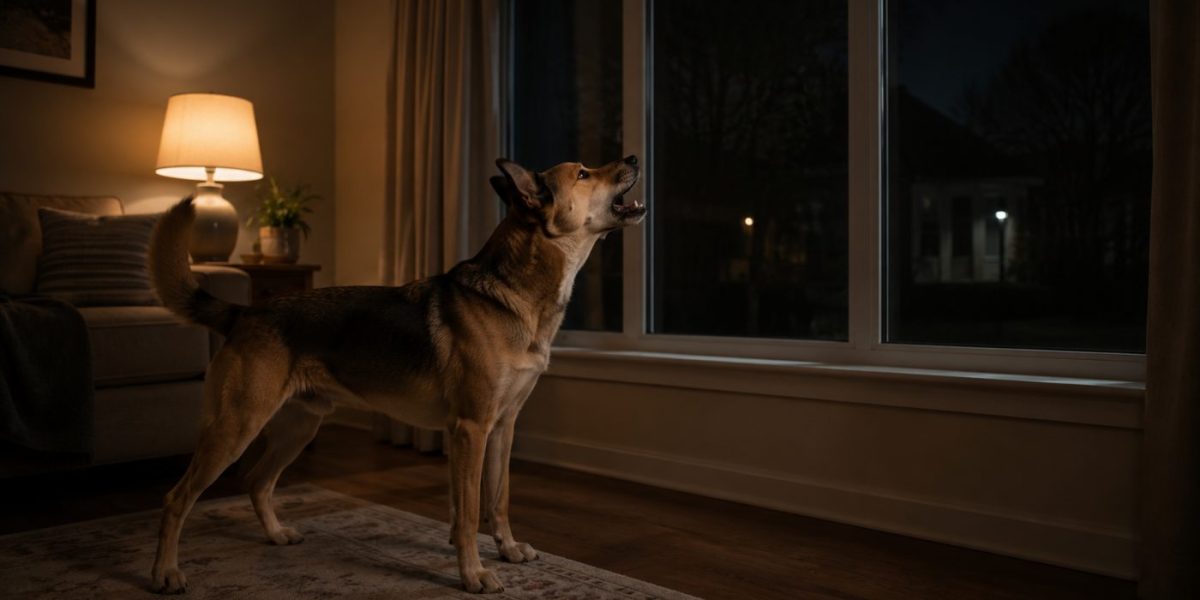

Your dog leaps up and barks furiously at a blank wall, an empty hallway, or the dark garden, and you stand there baffled because there is clearly nothing there. It is unsettling, a little spooky, and often annoying, especially at night. Here is the reassuring truth: your dog is almost never barking at nothing. They are barking at something you simply cannot see, hear, or smell, because their senses far outstrip ours. This guide explains what is really going on, walks through every common reason, and gives you a calm, kind plan to reduce the barking without shouting or stress.
It is probably not “nothing”
The single most important thing to understand is that dogs live in a richer sensory world than we do. They hear much higher frequencies and far fainter sounds than we can, and they see far better in low light, picking up tiny movements in a garden that looks pitch black to us. Their sense of smell is in another league entirely. So when your dog barks at “nothing,” they are very often reacting to a sound, a movement, or a scent that is completely real to them and completely invisible to you: a mouse in the wall, a fox three gardens away, a neighbour’s door, or a smell drifting under the front door. Once you accept there is usually a genuine trigger, the behaviour makes much more sense.

The common reasons
Super-senses picking up real triggers
As above, this is the leading cause. Distant sounds, faint smells, and small movements you cannot detect will set off an alert bark. It is your dog doing their self-appointed job of announcing anything new in the environment.
Boredom and pent-up energy
A dog with nothing to do will often bark simply to release energy and pass the time. Barking is self-rewarding, so an under-stimulated dog can fall into a habit of barking at every tiny thing. This is one of the most fixable causes, and more exercise and mental stimulation works wonders.
Attention seeking
Dogs are quick learners. If barking has ever made you look over, talk to them, or get up, they may bark to get your attention, and to them even a “no” is a response worth having. Watch whether the barking is aimed at you rather than the environment.
Fear or anxiety
An anxious dog is on high alert and quick to bark at anything that feels slightly off, especially unfamiliar sounds. If the barking comes with pacing, trembling, or clinginess, anxiety may be driving it, and the emotion underneath needs addressing, not just the noise.
Ageing and cognitive decline
In older dogs, new or unexplained barking, particularly staring and barking at walls or corners, can be a sign of canine cognitive dysfunction, a kind of doggy dementia. If your senior dog suddenly starts this, a vet check is wise.
Rule out pain or a medical cause first
If the barking is a sudden change in a dog who never used to do it, do not assume it is behavioural. Discomfort, failing hearing or eyesight, and age-related cognitive decline can all trigger new barking. A quick vet visit rules out or treats a medical cause, which no amount of training will fix on its own. This is always the responsible first step whenever a behaviour appears out of the blue.
How to calmly reduce the barking
- Do not shout. Raising your voice looks to your dog like you are barking along, which can make things worse and adds stress. Stay calm.
- Acknowledge, then move on. A relaxed “thank you” or “I’ve got it” tells your dog you have registered their alert and they can stand down. Many dogs settle once they feel heard.
- Reduce the triggers. Close curtains to block movement outside, use a fan or white noise to mask faint sounds, and keep your dog away from the window if they patrol it. Less to react to means less barking.
- Meet their needs. Make sure your dog gets enough physical exercise and brain work, because a satisfied dog barks far less out of boredom.
- Do not reward the barking. Avoid giving attention while your dog is barking. Wait for a pause, then reward the quiet.
- Teach a “quiet” cue. A trained off switch is invaluable. Our guide to teaching the quiet command shows you exactly how.
If it is anxiety
Barking that comes with genuine signs of distress, or that happens mostly when your dog is left alone, points to anxiety rather than simple alerting. In that case, more toys and a “quiet” cue will only go so far, because you need to help your dog feel safer. Create a calm, secure space, keep routines predictable, and work on the underlying fear gradually. Our guide to separation anxiety covers the gentle approach, and for a persistently anxious dog a qualified, reward-based behaviourist is well worth it.
What not to do
- Do not shout or punish. It adds stress, can look like joining in, and does nothing about the cause.
- Do not use shock or citronella anti-bark collars. They punish the symptom, increase fear, and can make anxious barking worse.
- Do not accidentally reward it. Fussing, feeding, or even scolding a barking dog can teach them barking works.
- Do not ignore a sudden change. New barking in a previously quiet dog deserves a vet check to rule out pain or cognitive decline.
Frequently asked questions
Why does my dog bark at nothing?
Usually it is not nothing. Dogs hear far higher and fainter sounds, see better in low light, and smell far more than we do, so they are reacting to a real trigger you cannot detect. Boredom, attention seeking, anxiety, and in older dogs cognitive decline can also cause it.
Should I be worried if my dog barks at nothing?
Occasional alert barking is normal. Be more concerned if it is sudden and out of character, comes with signs of distress or confusion, or appears in a senior dog, as these warrant a vet check to rule out pain, sensory loss, or cognitive decline.
Why does my dog bark at nothing at night?
At night your dog can hear and smell nocturnal wildlife and distant activity you cannot, and dark gardens are full of movement to their eyes. Boredom and a full day of rest can add to it. Closing curtains, masking sound, and a calm bedtime routine all help.
How do I stop my dog barking at nothing?
Stay calm and avoid shouting, acknowledge the alert then redirect, reduce triggers with curtains and white noise, meet their exercise and mental needs, avoid rewarding the barking, and teach a “quiet” cue. Rule out a medical cause if it is a sudden change.
Can boredom make a dog bark at nothing?
Yes, very commonly. Barking releases energy and is self-rewarding, so an under-stimulated dog often barks at tiny things out of habit. More exercise and mental stimulation usually reduces it noticeably.
The bottom line
When your dog barks at nothing, they are almost always barking at something real that your senses simply miss. Understanding that takes the mystery out of it. Rule out pain or cognitive decline if the barking is new, then stay calm, acknowledge and redirect, cut down the triggers, meet your dog’s need for exercise and enrichment, and teach a reliable “quiet” cue. Skip the shouting and the aversive collars, and address anxiety at its root if that is the cause. Do that and the mysterious barking settles right down. Next, learn the off switch in our guide to the quiet command, and tackle every cause of barking in our complete barking guide.
Sources and further reading: the American Kennel Club, WebMD Pets, and the ASPCA.