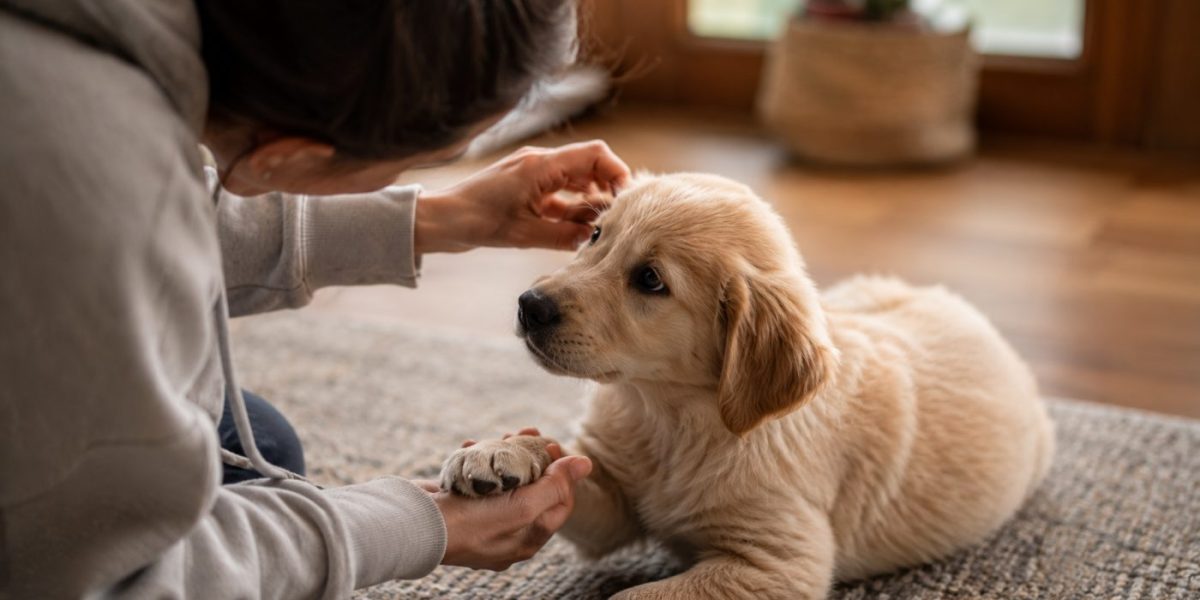

There is a lovely moment, usually somewhere in the first fortnight of life with a new puppy, when you say a small word out loud and a pair of ears swivel round to find you. That word is your puppy’s name, and getting them to respond to it is one of the very first things worth teaching. It sounds almost too simple to bother writing about, but a solid name response is the quiet foundation under everything else you will ever ask your dog to do. Before “sit”, before recall, before walking nicely on a lead, comes the ability to get your puppy’s attention in the first place. This guide walks you through exactly how to teach a puppy its name using gentle, reward-based methods, why it works the way it does, and the small mistakes that trip up most new owners without them ever realising.
What “learning a name” actually means to a dog
It helps to start with a slightly humbling truth. Your puppy does not think of their name the way you think of yours. To us, a name is an identity, a label that says “this is who I am”. To a dog, it is simply a sound that reliably predicts something. Researchers describe this as classical conditioning, the same quiet learning process that makes your own dog drift towards the kitchen the second they hear the treat cupboard open. The name is a cue, and the puppy learns what tends to follow it.
This is not just theory. Brain-imaging work at Eotvos Lorand University in Hungary used fMRI scanners to watch what happened inside dogs’ heads while they listened to familiar and unfamiliar words. Dogs showed more activity in the left side of the brain when they heard words that mattered to them, a region that in humans is tied to processing meaningful language. Separate research published in the journal Animal Cognition found that dogs respond more consistently to their actual name than to words with a similar rhythm and sound. In plain English, dogs really do pick their name out of the noise. They are not just reacting to any old syllable you throw at them.
What this tells us as trainers is reassuring. You do not need to explain anything to your puppy. You do not need them to understand. You simply need to make one sound, over and over, consistently mean “good things are about to happen, look this way”. Do that often enough and the response becomes automatic, almost a reflex. Get it wrong and the name quietly turns into background noise, a word they have learned to tune out. The difference between those two outcomes is almost entirely down to how you use the name in the first few weeks.
When to start and what you will need
You can begin the moment your puppy comes home, which is usually around eight weeks old. There is no waiting period and no minimum age that matters here. A very young puppy has a short attention span and tires quickly, so you work in tiny bursts, but the learning starts on day one. If you have just brought a puppy home and everything feels a bit chaotic, our guide to the first week with a new puppy pairs nicely with this, because name training slots neatly into those early settling-in days.
You will need almost nothing, which is part of the charm.
- Small, soft treats. Something your puppy can eat in one gulp without stopping to chew. Little pieces of cooked chicken, a soft training treat torn into fingernail-sized bits, or a portion of their own kibble if they are food-driven. Tiny is the operative word, because you will be handing out a lot of them.
- A quiet room. No telly, no other dogs, no children charging about. Distractions come later, on purpose, once the basics are solid.
- A cheerful voice. Free, and more important than any treat. Tone does a lot of the heavy lifting.
- A few spare minutes. Genuinely just a few. Short and frequent beats long and occasional every single time.
A clicker is optional. If you already use one and know how to charge it up, it makes your timing crisper. If clickers feel like faff, a clear spoken marker word such as “yes” does exactly the same job. The marker simply tells the puppy the precise instant they got it right, a fraction before the treat arrives.
The name game, step by step
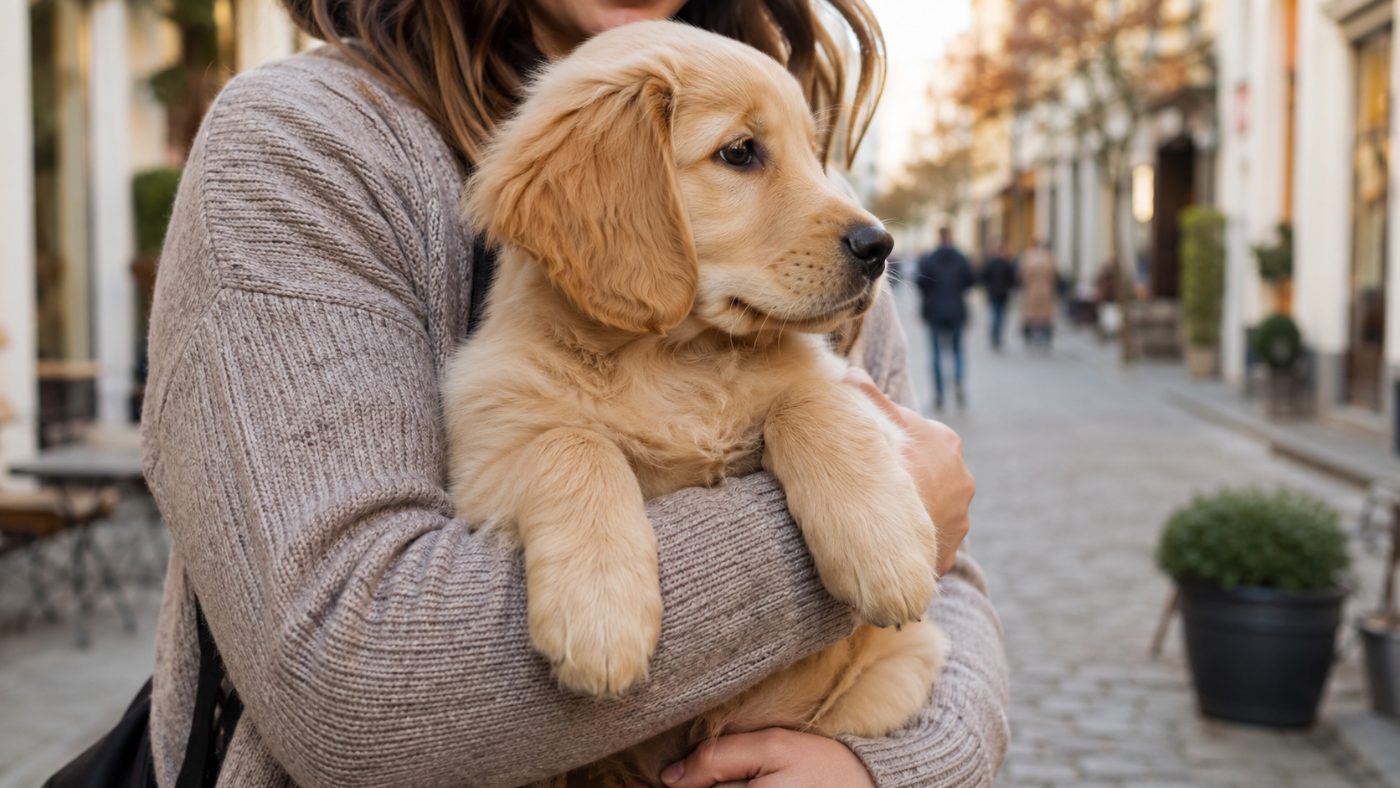
Here is the core exercise. Trainers sometimes call it the name game because, honestly, that is what it feels like to the puppy. Work through it in order and do not rush to the next stage until the current one is easy.
- Charge the name up first. For the first day or two, do not even ask for a response. Simply say your puppy’s name in a warm, bright voice and, the instant afterwards, pop a treat into their mouth. Name, treat. Name, treat. Ten or so repetitions, a couple of times through the day. You are building the association before you test it. The puppy is learning that this sound is worth caring about.
- Wait for the look. Now, when your puppy is pottering about nearby but not staring at you, say their name once in that same happy tone. The moment they turn their head towards you, mark it with “yes” or a click, then hand over the treat. That turn of the head is the behaviour you are paying for.
- Repeat until it is boringly reliable. Do a handful of reps, take a break, come back later. You are looking for your puppy to swing round to you four or five times out of five before you make anything harder.
- Add a little distance. Once the head-turn is dependable up close, step across the room and try again. Then from another room. Each time you increase difficulty, drop it briefly if the puppy struggles, then build back up.
- Ask for a bit more. Instead of rewarding the first flick of the head, wait for actual eye contact, that lovely moment where they look at your face. Reward that. You are refining a general “huh?” into a proper “yes, I’m listening”.
- Take the show on the road. Only now, with a rock-solid indoor response, do you introduce real-world distractions. The garden, the pavement, the park at a quiet time. Keep your puppy on a lead for safety and keep the treats coming.
Notice how gradual this is. Every stage is a slightly harder version of the same simple thing. Dogs learn beautifully when the difficulty creeps up in small steps, and they get flustered when you skip ahead. If your puppy suddenly stops responding, it almost always means you have made a jump too big, too soon. Back up a stage, get a few easy wins, and carry on. This same “make it easy, then make it harder” ladder is the backbone of teaching basic obedience commands too, so getting comfortable with it now pays off for years.
Why the happy voice matters so much
Dogs are extraordinarily tuned in to tone. Their hearing stretches far beyond ours, and they read emotion in a voice long before they understand any word in it. When you say a name brightly, with a little lift at the end, you are handing your puppy a signal that something good is coming. Say the very same name flatly, or worse, sharply, and you send the opposite message. This is the whole reason positive, reward-based training works: you are stacking pleasant associations, not issuing orders. If you want the underlying logic laid out properly, our explainer on positive reinforcement dog training is a good companion read.
There is a practical upshot here. The single fastest way to ruin a name is to use it when you are cross. If “Bella” only ever precedes chicken and cuddles, Bella will spin round every time. If “Bella” sometimes precedes a telling-off for chewing the skirting board, a small part of her starts to dread the word, and the response gets slower and more reluctant. Keep the name clean. It is only ever a summons to good things.
The mistakes almost everyone makes
Most name-training problems are not really training problems. They are habit problems on the human end. Here are the ones that do the most quiet damage.
Saying it over and over
The classic. Your puppy does not respond, so you repeat: “Rufus. Rufus. Rufus, come on. RUFUS.” Every unanswered repetition teaches your dog that the name does not actually require a response, and that if they wait long enough you will eventually stop. Over weeks, this trains a dog to ignore their own name. Say it once. If nothing happens, do not repeat. Instead, make yourself more interesting, close the distance, reduce the distraction, and set up an easier win. One name, one chance, then help them succeed.
Gluing the name to every command
It is natural to say “Rufus, sit” as one lump. But then the name becomes part of the command rather than a standalone attention cue. You want to be able to say “sit” on its own, and separately be able to say the name to get a head-turn. Keep them apart in training. Say the name, wait for the look, then, as a separate beat, ask for the sit.
Too many nicknames, too soon
We all do it. Rufus becomes Roo, then Roo-Roo, then Mr Woofles, then “oi, you”. A puppy still learning the sound of their real name gets muddled when the sound keeps changing. Pick one name and use it consistently for the first few weeks. Nicknames are lovely, and your dog will happily learn them later, once the main name is bulletproof.
Everyone saying it differently
If one person in the house says the name with a gentle rise and another barks it flat, the puppy has two puzzles to solve instead of one. Get the whole household on the same page. Same name, same cheerful energy, same “say it once” rule. This matters even more in busy homes and dovetails with keeping other routines consistent, which is exactly why a shared puppy training schedule by age is so useful for families.
Rewarding too slowly
The treat needs to land within a second or two of the head-turn, or the puppy struggles to connect the two. This is what the marker word is for. “Yes” buys you a moment to get the treat out of your pocket while the puppy still knows precisely what earned it.
How long does it take?
Honest answer: it varies, and anyone giving you a single number is oversimplifying. Many puppies start turning to their name within the first day or two of the name game, because the exercise is so simple and the reward is so immediate. That early response, though, is fragile. It works in a quiet room with no distractions and a pocket full of chicken.
A genuinely reliable name response, the kind that works in the park with squirrels about, takes longer. As a rough guide, expect two to four weeks of short, consistent daily practice for a young puppy to respond dependably in ordinary situations. Building it to work under real distraction can take a couple of months of ongoing reinforcement. None of this is a race. A dog who turns to their name nine times out of ten in a calm setting is doing brilliantly, and the last mile of proofing under heavy distraction is a lifelong top-up rather than a one-off exam you pass and forget.
Puppies who seem slow are usually not slow at all. They are typically being asked to work with too many distractions, or they are tired, or the treats are not exciting enough, or the name has been accidentally poisoned by being used for tellings-off. Fix the setup and the puppy almost always catches up quickly.
Choosing a name that is easy to learn
If you have not settled on a name yet, you can stack the odds in your favour. Puppies find some names genuinely easier to pick out than others.
- Short is better. One or two syllables sit cleanly in a dog’s ear. Long, elaborate names get shortened in practice anyway, so you may as well train the short version.
- Crisp consonants help. Hard sounds such as the K in “Milo” or the B in “Bella” cut through better than soft, mushy ones. They give the puppy a distinct edge to latch onto.
- Avoid command clashes. Steer clear of names that rhyme with cues you will use constantly. “Kit” sounds an awful lot like “sit”, and “Beau” or “Joe” can blur into “no”. You do not want your dog second-guessing whether they heard their name or an instruction.
- Pick something you are happy to shout in public. A minor point, but you will be calling this name across a field for the next decade, so choose one you can holler cheerfully without cringing.
Renaming a rescue or an older dog
Plenty of dogs come to us with a name that does not suit, or with a history you would rather not carry forward. The good news is that dogs have no sentimental attachment to their name the way we do. To them it is just a sound, and sounds can be swapped. Renaming uses exactly the same method as teaching a puppy from scratch: pair the new name with treats, meals, play and affection, keep the tone bright, and simply stop using the old one. An adult dog may take a little longer than a young puppy, perhaps four to eight weeks of consistent practice, but they get there. If the previous name had picked up bad associations, a fresh start can genuinely help a nervous dog feel more comfortable.
Weaving the name into everyday life
Formal sessions are only half the job. The real magic is in the hundreds of tiny, unstructured moments where you use the name well. Say it before you put the food bowl down. Say it before a walk. Say it and, when your puppy comes over, ruffle their ears and tell them they are wonderful. Every one of these is a rep, and they add up faster than any dedicated training block.
A name response also underpins the bigger safety skills you will build later. A puppy who reliably turns to their name is far easier to teach recall to, easier to redirect away from something they should not have, and easier to keep safe near roads. It is the attention switch you flick before anything else. As your puppy grows and you start layering in socialisation around new people, dogs and places, that instant “look at me” response becomes worth its weight in gold, because it lets you reconnect with your puppy in the middle of an exciting, overwhelming world.
One last gentle reminder. Keep it kind and keep it fun. There is never any need for harsh corrections, shouting or aversive tools to teach a name, and those things actively work against you here, because they poison the very association you are trying to build. A puppy who loves the sound of their own name is a puppy who will keep checking in with you for the rest of their life. That relationship, more than any single command, is what good training is really about. For the wider view on how modern trainers approach all of this, the American Kennel Club, the RSPCA and Best Friends Animal Society all offer sound, reward-based guidance that lines up with everything here.
Frequently asked questions
At what age can I start teaching my puppy its name?
Straight away, from the day they come home, which is usually around eight weeks old. There is no minimum age that matters. Very young puppies tire quickly and have short attention spans, so keep sessions to a couple of minutes and do several of them across the day rather than one long slog. The learning genuinely starts on day one, even if the reliable response takes a few weeks to firm up.
Why does my puppy ignore its name?
Usually one of a few things. The name may have been repeated so often without a response that your puppy has learned to tune it out. It may have been used during tellings-off, giving it a slightly sour association. Or there are simply too many distractions and the treats are not exciting enough to compete. Go back to a quiet room, use higher-value rewards such as chicken, say the name only once, and reward the head-turn instantly. The response almost always comes back.
Should I use a clicker to teach my puppy its name?
You can, but you do not have to. A clicker gives you very precise timing, marking the exact instant your puppy looks at you. If you are comfortable with one, brilliant. If not, a clear spoken marker word like “yes”, said the moment they turn towards you and followed quickly by a treat, does the same job. What matters is the crisp timing and the reward, not the tool.
Can two people teach a puppy the same name?
Yes, and a whole household should get involved. The key is consistency: everyone uses the same name, the same cheerful tone, and the same “say it once” rule. Where families go wrong is when one person says the name softly and another says it sharply, or when nicknames start flying about too early. Agree on one name and one approach, and your puppy learns faster because there is only one puzzle to solve.
Is it too late to change my adult dog’s name?
It is never too late. Dogs do not feel attached to their names the way people do, so renaming is completely fine and often helpful with rescues. Use the exact same method as with a puppy: pair the new name with treats, meals, play and affection, keep your voice bright, and stop using the old name entirely. An adult may need four to eight weeks of consistent practice rather than a couple, but with patience they learn the new name happily.
The bottom line
Teaching a puppy its name is not really about the name at all. It is about building the very first thread of communication between you, a reliable little switch that says “look at me, good things happen when you do”. Keep the method kind and simple: say the name once in a warm voice, reward the moment your puppy looks, and slowly raise the difficulty as they get the hang of it. Protect the name by never using it in anger, resist the urge to repeat it, and get the whole household saying it the same way. Do that for a few weeks and you will have a puppy who whips round the second they hear their name, delighted rather than dutiful. Everything else you go on to teach, from recall to lead walking to a rock-solid sit, is built on that first small, joyful bit of listening.